Bedroom Feng Shui: Simple Changes for a Better Night’s Sleep
Sep 14, 2026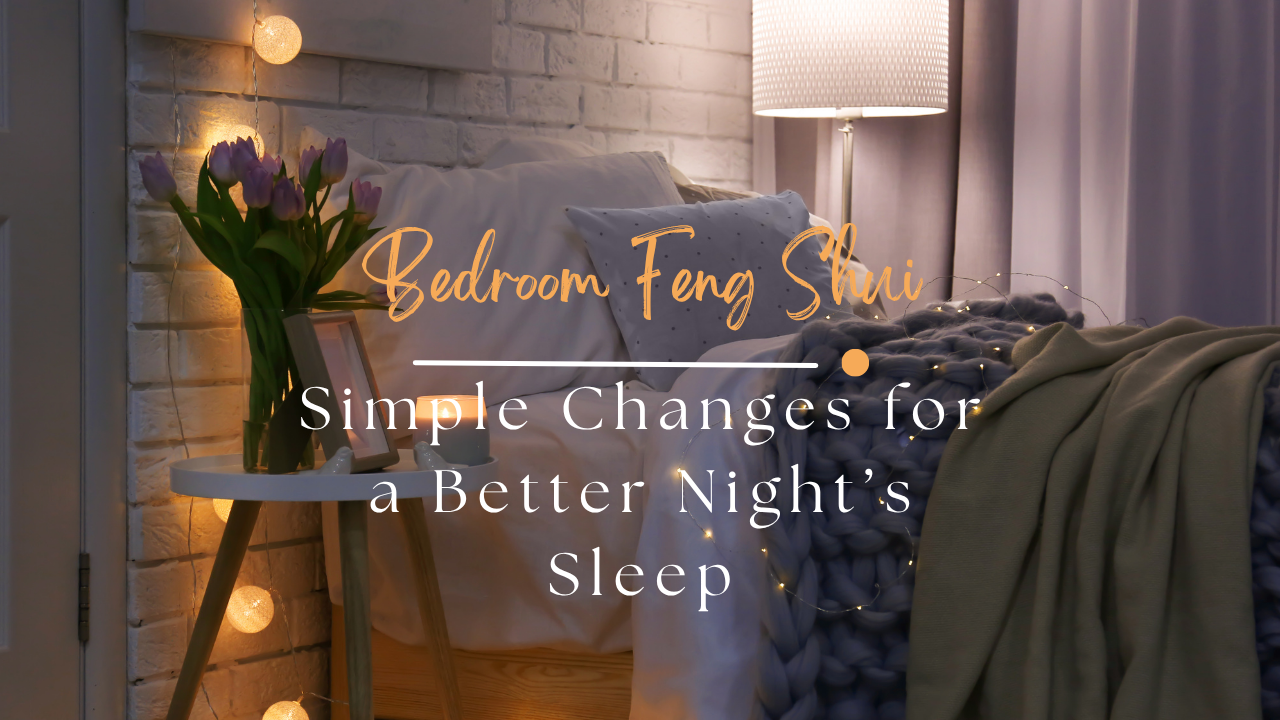
Bedroom Feng Shui: Simple Changes for a Better Night’s Sleep
Your bedroom should be one of the most peaceful rooms in your home.
It is where you go to rest, recharge and reset after the day. But from a Feng Shui perspective, there are certain things about your bedroom and the position of your bed that can influence the quality of the energy around you.
Good bedroom Feng Shui isn't about making your room look a certain way. It is about creating an environment that feels supported, settled and restful.
Here are some of the simple things I look for when considering bedroom Feng Shui.
Start with the ceiling
Take a look at what is directly above your bed.
Ideally, you want a clear, even ceiling above you. If your bedroom has a sloping ceiling, particularly where the slope comes down over the bed, it can create a feeling of pressure or restriction.
The same applies to heavy beams.
If you have exposed beams, shelving or cupboards directly above your head, consider whether they can be moved or changed.
From a Feng Shui perspective, we don't want anything heavy hanging over the position where you sleep.
And practically, your bedroom should feel like a place where you can completely switch off. Anything that makes the space feel heavy or oppressive isn't ideal.
Don't sleep underneath exposed beams
Exposed beams can create strong downward energy.
If your bed has to remain underneath one, you may be able to soften the effect by repositioning the bed or, where appropriate, covering or disguising the beam.
The aim is to create a more balanced and comfortable sleeping environment.
Be mindful of what is behind your bed
One of the most important things to consider is what is directly behind the head of your bed.
In traditional Feng Shui, a solid wall behind the bed is generally preferred.
It gives the bed a feeling of support and stability.
If possible, avoid positioning your bed directly in front of a window. A window doesn't provide the same solid support as a wall and can make the position feel less settled.
If you have no choice but to place your bed beneath a window, good-quality curtains or blinds can help create a greater sense of enclosure when you sleep.
What is on the other side of the wall?
This is something that can easily be overlooked.
If your bed is against a wall that backs onto a bathroom or toilet, it is worth considering the position carefully.
Water and drainage pipes can create movement behind the wall, and traditionally we would avoid placing the head of the bed directly against this type of energy if another option is available.
Again, don't panic if this is the only possible position for your bed.
Feng Shui is about working with the space you have.
Watch out for sharp corners
Look around your bedroom and notice whether any corners or edges of furniture point directly towards your bed.
In Feng Shui, sharp or prominent corners can create what is sometimes referred to as negative or Sha Chi.
You don't need to become obsessed with every corner in your home, but if you have a particularly large, sharp-edged piece of furniture pointing directly towards where you sleep, it is worth seeing whether you can reposition it.
Sometimes a very small change can make a room feel much more comfortable.
Give your bed space to breathe
Ideally, you want Chi to be able to circulate freely around your bed.
This means avoiding filling the space underneath your bed with lots of storage.
I know that under-bed storage can be incredibly useful, especially when space is limited, but from a traditional Feng Shui perspective, a clear space underneath the bed is preferable.
If you absolutely need to use the space, keep it organised and avoid storing anything that carries strong emotional associations, such as old paperwork, work-related items or things you no longer want.
Your bedroom should feel like a place for rest rather than somewhere that stores yesterday's problems.
What about mirrors?
Mirrors are another common bedroom Feng Shui question.
A mirror is considered very active or Yang in nature because it reflects light and moves energy around.
The bedroom, on the other hand, is a place where we want a more restful, Yin quality.
For this reason, I would be cautious about having a large mirror directly facing your bed.
If you have a wardrobe with mirrored doors opposite the bed and find that it makes you uncomfortable, try covering the mirrors at night and see whether you notice a difference.
As with everything in Feng Shui, your own experience matters too.
Keep the bedroom calm
Think carefully about what you bring into your bedroom.
Your bedroom isn't really the place for a home office, piles of paperwork, exercise equipment or anything else that reminds you of work and activity.
We want this room to communicate one simple message:
It's time to rest.
Soft lighting, comfortable bedding, natural materials and a relatively uncluttered environment can all help create a more restful atmosphere.
You don't need to completely redesign your bedroom.
Sometimes simply removing things that don't belong there can make a surprisingly big difference.
Your bed position matters
The position of your bed is particularly important in Feng Shui.
Ideally, you want your bed to feel protected and supported, with a solid wall behind the headboard and a clear view towards the bedroom door without being directly in line with it.
There should also ideally be enough space around the bed for energy to circulate.
If you're sharing a bedroom, having reasonable space on both sides of the bed can also help create balance.
Your personal direction can also be important
This is where we can take bedroom Feng Shui a step further.
In traditional Feng Shui, we can look at your Life Gua to identify your four auspicious and four inauspicious directions.
Your Life Gua is personal to you and does not change throughout your life.
One of the ways I use this information is to look at the direction you sleep.
Your bed can be positioned so that the crown of your head is facing towards one of your more favourable directions.
This gives us a more personalised approach rather than simply applying exactly the same Feng Shui rules to everyone.
And this is one of the reasons I love working with Life Gua.
Your home isn't just a collection of rooms. It is your environment, and your environment can be considered alongside who you are.
Don't forget the rest of the home
Your bedroom is important, but it is only one part of the Feng Shui of your home.
Traditional Feng Shui looks at the environment as a whole.
The land and surroundings, the shape and orientation of your home, the main entrance, the internal layout and the way the different energies interact all contribute to the bigger picture.
We can then look at specific areas such as your bedroom and make more personal adjustments.
This is why I don't believe Feng Shui should be about simply placing an object in a particular corner and expecting everything to change.
It is much more useful when you understand why something is being recommended and how it relates to your particular home.
A simple bedroom Feng Shui checklist
Before you go to bed tonight, have a quick look around your bedroom.
Ask yourself:
-
Is there anything heavy directly above my bed?
-
Do I have a solid wall supporting the head of my bed?
-
Is my bed positioned directly underneath a window?
-
Is there a bathroom or toilet behind the head of my bed?
-
Are any sharp corners pointing directly towards me?
-
Is the space underneath my bed clear and organised?
-
Is a large mirror facing my bed?
-
Does my bedroom feel calm and restful?
-
Am I surrounded by things that encourage relaxation rather than work and activity?
-
Do I know which of my Life Gua directions could support me while I sleep?
You don't have to change everything at once.
Choose one or two things that you can easily improve and start there.
Your bedroom should support you
Feng Shui isn't about creating a perfect home.
It's about understanding your environment and making thoughtful changes that help your home support the life you want to live.
And when it comes to your bedroom, the goal is simple:
Create a space where you feel supported, settled and able to switch off.
If you'd like to take your bedroom Feng Shui further, discovering your Life Gua can be a great place to start. It can show you your personal favourable directions and give you another layer of information when considering your bed, desk or study position.
About the Author
Victoria Stoker is the founder of What The Feng Shui and a Traditional Feng Shui practitioner dedicated to making authentic Feng Shui simple, practical and easy to understand. Through online courses, YouTube videos and educational resources, she teaches people how to use Traditional Compass School Feng Shui to create healthier, happier and more harmonious homes.
Begin your journey with the FREE Feng Shui Beginners Kit, or explore The Feng Shui Blueprint to learn how to confidently apply Traditional Feng Shui throughout your entire home.
Your home should work with you — not against you.
Balance your home. Empower your life.
Lorem ipsum dolor sit amet, consectetur adipiscing elit. Cras sed sapien quam. Sed dapibus est id enim facilisis, at posuere turpis adipiscing. Quisque sit amet dui dui.
Stay connected with news and updates!
Join our mailing list to receive the latest news and updates from our team.
Don't worry, your information will not be shared.
We hate SPAM. We will never sell your information, for any reason.